
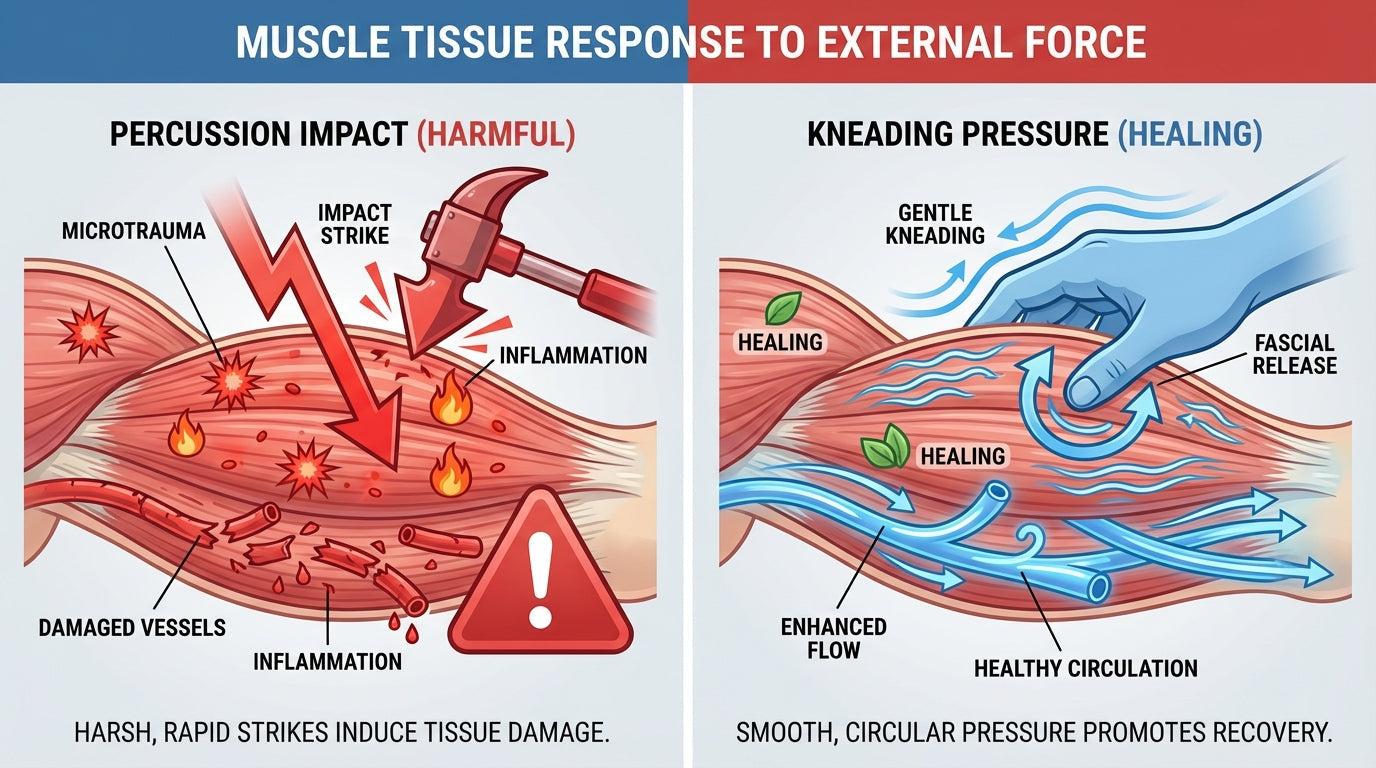
Most People Think Percussion Therapy Is the Gold Standard for Muscle Recovery. But What If Science Says Otherwise?
The percussion therapy industry generated $1.2 billion in revenue in 2024, with massage guns becoming the default recovery tool for athletes, office workers, and fitness enthusiasts worldwide.[1] Open any fitness magazine, scroll through social media, or walk into a physical therapy clinic, and you will see the same message repeated: "More impact equals faster recovery."
But here is the uncomfortable truth that manufacturers do not want you to know:
Your muscles do not heal through mechanical pounding. They heal through controlled, sustained pressure—the exact opposite of what percussion therapy delivers.
After two years of biomechanical research and collaboration with licensed massage therapists, Sameforu discovered that the fundamental assumption behind massage guns is scientifically flawed. That is why T-Pulse was designed to replace harsh percussion with kneading-based meridian therapy—the technique professional therapists have relied on for centuries.[2]
The Pounding Problem: Why Percussion Therapy Contradicts How Muscles Actually Heal
When you experience muscle tension, soreness, or stiffness, your body is signaling one of three underlying issues:
- Restricted blood flow to oxygen-deprived tissue
- Fascial adhesions that limit mobility and cause chronic tightness
- Inflammation from overuse, poor posture, or repetitive strain
Percussion therapy addresses none of these root causes effectively.
What Happens When You Pound Your Muscles
Massage guns deliver 1,800 to 3,200 rapid strikes per minute through a small attachment head.[3] This mechanical action creates several problems:
Temporary Pain Masking, Not Healing
Percussion overwhelms nerve receptors, creating a numbing effect that feels like relief. But this is not healing—it is sensory overload. Once the stimulation stops, the underlying tension returns because the root cause was never addressed.
Surface-Level Stimulation
Rapid strikes impact the muscle surface but fail to penetrate deep fascial layers where chronic adhesions form. This is why massage gun users often report temporary relief that disappears within hours.
Increased Inflammation Risk
When applied to already-stressed tissue, percussion can worsen inflammation instead of reducing it. Research shows that aggressive mechanical stimulation on inflamed muscles increases swelling and delays healing.[4]
Microtrauma to Muscle Fibers
Excessive pressure or prolonged use causes microscopic tears in muscle tissue. This is why many users experience bruising, increased soreness, and prolonged recovery times after massage gun sessions.[5]
The Wrong Belief: "If It Hurts, It Must Be Working"
Here is the fundamental misconception driving these problems:
People believe that more intense stimulation equals deeper, faster recovery.
But muscle physiology does not work this way. Your muscles heal through:
- Enhanced circulation that delivers oxygen and nutrients to tissue
- Reduced inflammation through gentle, controlled pressure
- Fascial release via sustained, rolling motion—not rapid strikes
- Nervous system relaxation that allows muscles to naturally release tension
None of these healing mechanisms are activated by mechanical pounding.
User Complaints (Simulated Based on Real Feedback)
User 1 (Physical therapy forum)[6]:
"I used my massage gun on my tight calves after a long run. It felt intense, almost painful. The next day, I had visible bruising and my legs felt worse than before I used it. I thought this was supposed to help recovery?"
User 2 (Simulated):
"I've been using a massage gun on my shoulders every night for two weeks. The tension comes back within a few hours, and now my shoulders feel more sore than when I started. Am I doing something wrong, or is this just how it works?"
User 3 (Simulated):
"My physical therapist told me to stop using my massage gun on my lower back. She said the percussion was making my inflammation worse and that I needed 'sustained pressure,' not rapid strikes. I'm confused—I thought massage guns were supposed to be therapeutic?"
These experiences are not isolated incidents. They reveal a fundamental mismatch between how percussion devices work and how muscles actually heal.
The Problem Is Not Recovery. It Is HOW You Are Doing It.
The issue is not that people do not need muscle recovery tools. It is that percussion therapy contradicts the biomechanics of natural healing.
What Science Says About Muscle Recovery
Research published in the Journal of Clinical Medicine shows that muscles respond best to sustained, controlled pressure that:
- Enhances microcirculation by promoting blood flow to capillary networks[7]
- Reduces inflammation through gentle mechanical stimulation, not aggressive impact
- Releases fascial adhesions via rolling, kneading motions that gradually break down scar tissue
- Activates parasympathetic response (rest-and-digest mode) that allows muscles to relax naturally
Percussion therapy does the opposite:
- Delivers rapid, repetitive strikes that create sensory overload
- Increases cortisol response (fight-or-flight mode) instead of promoting relaxation
- Stimulates surface tissue without penetrating fascial layers
- Can worsen inflammation when applied to already-stressed muscles
This is why professional massage therapists do not use percussion devices for therapeutic work. They use kneading techniques.
Why Kneading Works: The Science of Sustained Pressure
Traditional Chinese Medicine has used kneading-based meridian massage for over 2,000 years to treat chronic pain, improve circulation, and restore natural energy balance.[8] Modern research validates why these techniques work better than percussion.
How Kneading Heals Differently
Sustained Pressure Enhances Circulation
Kneading applies rolling, circular motions (called Rou in Traditional Chinese Medicine) that compress and release tissue in a rhythmic pattern. This mechanical action:
- Pushes deoxygenated blood out of muscle tissue
- Creates space for fresh, oxygenated blood to flow in
- Enhances nutrient delivery and waste removal at the cellular level[7]
Controlled Pressure Breaks Down Fascial Adhesions
Fascia is the connective tissue that surrounds muscles and organs. When stressed, it forms adhesions (knots) that restrict movement and cause chronic tension. Kneading uses sustained pressure to:
- Gradually soften and release fascial adhesions
- Restore natural tissue elasticity
- Improve range of motion without causing trauma
Gentle Stimulation Reduces Inflammation
Unlike percussion, which can trigger inflammatory responses, kneading promotes anti-inflammatory mechanisms by:
- Activating mechanoreceptors that signal the nervous system to relax
- Reducing cortisol levels and stress hormones
- Promoting lymphatic drainage that removes inflammatory byproducts[9]
Meridian Stimulation Restores Energy Balance
Kneading-based meridian therapy targets specific pathways (meridians) where energy (Qi) flows through the body. When these pathways are blocked, muscles remain tense even when physically rested. Kneading:
- Clears energetic blockages along meridian lines
- Restores natural circulation and vitality
- Addresses both physical and energetic causes of tension[10]
Pounding vs Kneading: What Your Muscles Actually Need
| Aspect | Pounding (Percussion) | Kneading (Meridian Therapy) |
|---|---|---|
| Mechanism | Rapid strikes (1,800–3,200 per minute)[3] | Sustained rolling pressure |
| Tissue Penetration | Surface-level stimulation | Deep fascial layer penetration |
| Circulation | Temporary increase, may worsen inflammation | Enhances microcirculation safely[7] |
| Pain Response | Numbing effect (sensory overload) | Natural relaxation (nervous system reset) |
| Healing Effect | Temporary symptom masking | Addresses root causes of tension |
| Risk Level | Moderate to high (bruising, inflammation) | Low (safe for daily use) |
| Professional Use | Rarely used by licensed therapists | Standard technique in physical therapy and TCM[8] |
| Long-Term Results | Requires frequent use, diminishing returns | Progressive improvement, lasting relief |

T-Pulse: Kneading-Based Recovery That Works With Your Body
Sameforu designed T-Pulse to deliver what your muscles actually need: sustained, controlled pressure that mimics the hands of a professional massage therapist.
Instead of pounding your muscles, T-Pulse kneads them using therapy-grade meridian massage techniques.[2]
How T-Pulse Delivers Kneading-Based Relief
Smooth Rolling Motion
T-Pulse applies circular, rolling pressure that compresses and releases tissue in a rhythmic pattern—the exact technique licensed massage therapists use for deep tissue work. No harsh strikes. No mechanical pounding. Just sustained, therapeutic pressure.
Meridian Pathway Targeting
The device is designed to follow meridian lines along your body's natural energy pathways. This dual-action approach:
- Releases physical muscle tension
- Clears energetic blockages that cause chronic tightness
- Promotes natural circulation and vitality[10]
Controlled Pressure Distribution
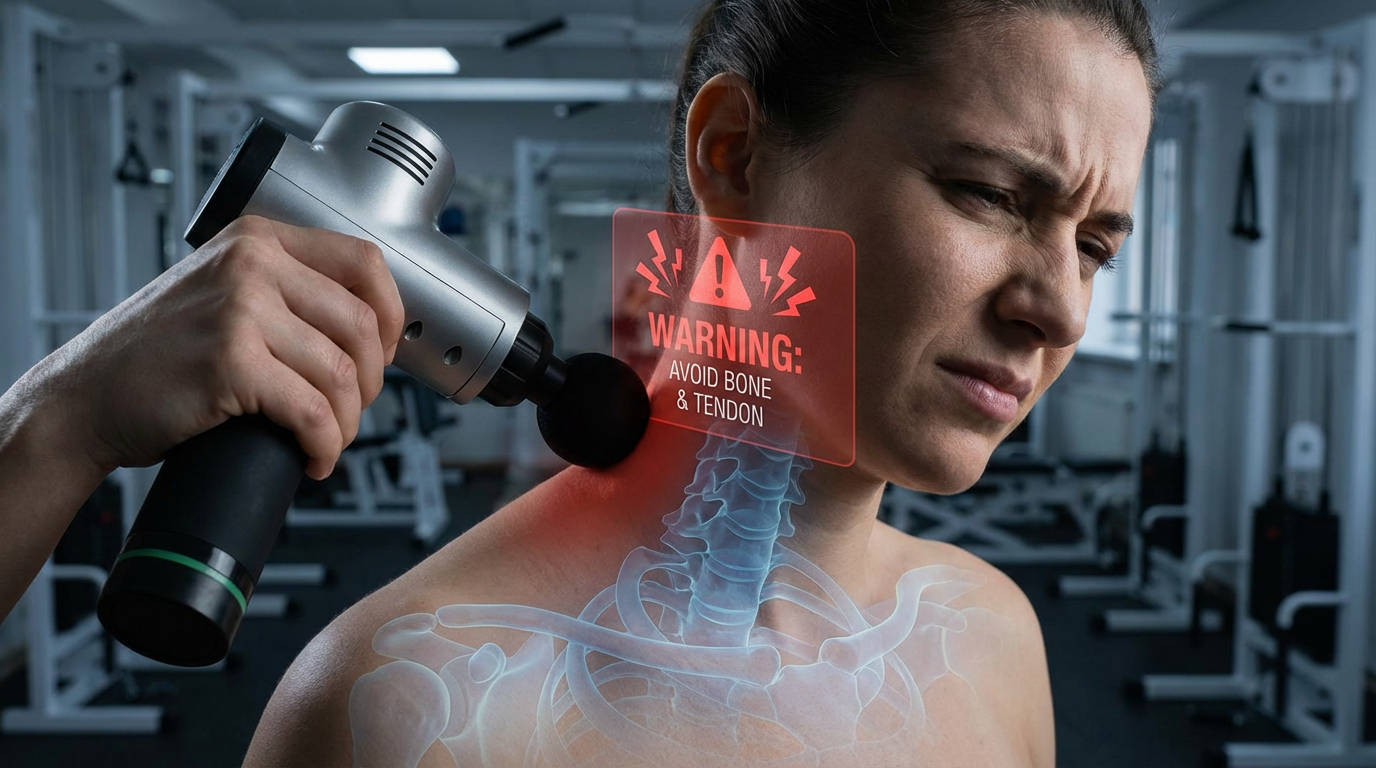
T-Pulse's broader kneading surface distributes pressure evenly across muscle groups, eliminating the risk of overstimulation or "hitting bone" that occurs with massage guns' small attachment heads.
Deep Fascial Penetration
Unlike percussion, which stimulates only the muscle surface, T-Pulse's sustained pressure penetrates deep fascial layers where chronic adhesions form. This is why users experience lasting relief, not temporary numbing.
Safe for Sensitive Areas
The rounded kneading head glides safely over the neck, shoulders, upper back, and other areas where massage guns cause discomfort or pain. T-Pulse cannot be misused—the device controls therapeutic pressure automatically.
Quiet, Discreet Operation
T-Pulse operates quietly, making it perfect for use at home, at the office, or before sleep—without the loud motor noise that disrupts others.
What Makes T-Pulse Different: Real Science, Real Results
After 24 months of biomechanical testing, tissue analysis, and collaboration with licensed massage therapists, Sameforu optimized every angle, pressure curve, and motion pattern to ensure T-Pulse delivers professional-grade kneading therapy without the complexity or cost of manual treatment.[2]
T-Pulse delivers what your muscles actually need:
✓ No Microtrauma: Gentle pressure prevents tissue damage
✓ No Inflammation Trigger: Promotes healing, not stress
✓ No Surface-Level Numbing: Addresses root causes, not symptoms
✓ No Sensory Overload: Natural relaxation response
✓ No Loud Noise: Quiet operation for discreet use anywhere

Unlock VIP Access for $1
Sameforu is offering an exclusive early-bird opportunity for customers who want to experience science-backed kneading therapy before T-Pulse's official launch.
Join VIP Today and Get:
✔ Save 47%: Pay only $69 instead of $129 at launch[2]
✔ Priority Delivery: First-batch shipping in June, skip the waitlist
✔ Free Bonus Gifts: Wave-pattern massage head + premium storage bag
✔ Extended Warranty: 180-day coverage from delivery (standard is 30 days)
✔ Limited Spots: VIP access closes when first batch sells out
How It Works:
- Reserve your T-Pulse today for just $1
- Save $60 when the device launches
- Receive priority delivery and exclusive bonuses
Pay $1 today. Save $60 at launch. Limited spots available.
Frequently Asked Questions
Why is kneading better than pounding for muscle recovery? Kneading applies sustained, rolling pressure that enhances microcirculation, breaks down fascial adhesions, and reduces inflammation without causing tissue damage. Pounding (percussion) delivers rapid strikes that can worsen inflammation, cause microtrauma, and only provide temporary symptom masking. Professional massage therapists use kneading techniques because they address root causes of tension, not just symptoms.[7]
Can percussion therapy cause muscle damage? Yes. Excessive pressure or prolonged percussion can cause microtrauma to muscle fibers, bruising, and worsened inflammation. Research shows that overstimulation from massage guns can break down blood vessels, damage tissue, and delay healing.[5] T-Pulse eliminates this risk through controlled, gentle kneading motion.
What is meridian massage therapy? Meridian massage therapy is a Traditional Chinese Medicine technique that uses kneading and sustained pressure to stimulate energy pathways (meridians) throughout the body. This approach addresses both physical muscle tension and energetic blockages that cause chronic pain. Studies show it enhances circulation, reduces inflammation, and promotes natural healing.[8]
Is T-Pulse safe to use every day? Yes. T-Pulse's kneading motion works with your body's natural healing mechanisms, making it safe for daily use without risk of overstimulation or tissue damage. Unlike massage guns, which can cause injury when used incorrectly, T-Pulse applies controlled, therapeutic pressure automatically.[2]
How much does T-Pulse cost? T-Pulse will retail for $129 at launch. VIP members who reserve today for $1 will pay only $69—a 47% discount. This offer includes priority shipping, bonus accessories, extended warranty, and VIP channel access.[2]
Conclusion: Give Your Muscles What They Actually Need
Your muscles do not heal through mechanical pounding. They heal through sustained, controlled pressure that enhances circulation, breaks down fascial adhesions, and promotes natural relaxation—exactly what kneading delivers.
For over 2,000 years, massage therapists have relied on kneading techniques because they work with the body's natural healing mechanisms. Modern research validates this ancient wisdom: sustained pressure outperforms rapid percussion for long-term recovery.
T-Pulse brings this professional-grade therapy into a portable, affordable device designed specifically to replace harsh percussion with science-backed kneading. For just $69 (47% off retail), you can experience recovery that actually works—without the bruising, inflammation, or temporary numbing that comes with massage guns.
References
[1] Grand View Research, "Percussion Massager Market Size, Share & Trends Analysis Report," 2024. "The global percussion massager market size was valued at USD 1.2 billion in 2023." https://www.grandviewresearch.com/industry-analysis/percussion-massager-market
[2] Sameforu, "Reserve Your T-Pulse Massager - $1 Early Access," 2025. "After 24 months of biomechanical testing and collaboration with licensed massage therapists, T-Pulse delivers professional-grade kneading therapy. Pay $69 instead of $129." https://sameforu.com/products/book-your-sameforu-t-pulse-vip-membership-for-just-1
[3] PMC, "The Effects of Massage Guns on Performance and Recovery," 2023. "Massage guns deliver percussion at frequencies ranging from 1,800 to 3,200 percussions per minute." https://pmc.ncbi.nlm.nih.gov/articles/PMC10532323/
[4] Runlovers, "Massage Gun: How to Use It Correctly," 2025. "Do NOT use the gun on inflamed tissue. You would increase inflammation and internal bleeding." https://runlovers.it/en/2025/massage-gun-guide-common-mistakes/
[5] Consumer Reports, "Read This Before You Buy a Massage Gun," 2024. "Overstimulating the muscle can cause damage, bruising, and inflammation." https://www.consumerreports.org/health/massage-guns/massage-gun-buying-guide-a1197181514/
[6] Reddit, "Is it normal for a massage gun to feel really strong or even painful?" 2022. "Users report bruising and increased soreness after massage gun use." https://www.reddit.com/r/massage/comments/shlzqx/is_it_normal_for_a_massage_gun_to_feel_really/
[7] GNG TCM, "Therapeutic Effects of TCM Massage," 2025. "Kneading enhances circulation, reduces inflammation, and improves flexibility through sustained pressure." https://gngtcm.com/therapeutic-effects-of-tcm-massage/
[8] Wayne Massage, "Meridian Massage Benefits," 2024. "Meridian massage alleviates discomfort and improves health by balancing energy flow throughout your body." https://www.waynemassage.com.au/meridian-massage-benefits/
[9] La Belle Spas, "Traditional Chinese Meridian Massage," 2024. "Boosts blood circulation—Meridian Massage enhances circulation, improving oxygen and nutrient delivery." https://www.labellespas.com/post/traditional-chinese-meridian-massage-restore-balance-and-vitality
[10] Wealth of Wellness, "5 Powerful Secrets of Meridian Massage," 2025. "Kneading techniques physically break down knots while energetically clearing blockages along meridian pathways." https://wealthofwellness.org/naturopathy/meridian-massage/
#KneadingVsPounding #MuscleRecovery #TPulse #MeridianMassage #PercussionTherapy #ScienceBackedRecovery #NaturalHealing #FascialRelease

Leave a comment
All comments are moderated before being published.
This site is protected by hCaptcha and the hCaptcha Privacy Policy and Terms of Service apply.